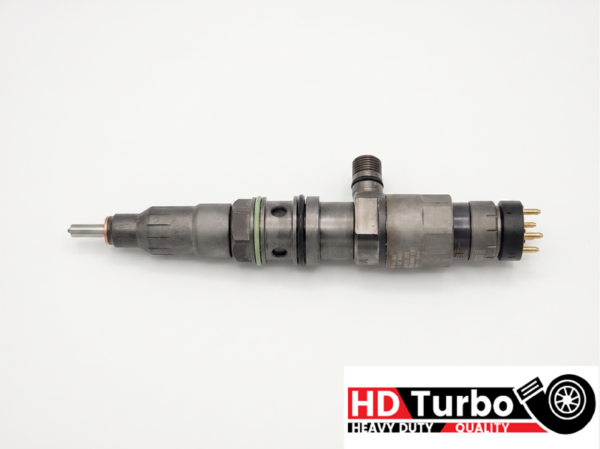
Key Insights
- Remanufactured means a documented process specification: full disassembly, all wear components replaced with new, reassembly to OE spec, and flow/leak/spray testing. Rebuilt means the broken parts were fixed. Refurbished usually means cleaned. The terms are not interchangeable and are not regulated.
- Remanufactured injectors typically run 40–60% of new cost, because the precision-machined core body is recovered rather than re-made.
- Contamination control is the process step that matters most. Common-rail injectors run above 30,000 psi through orifices measured in hundredths of a millimeter. Industry benchmark practice is Class-100,000 clean-room assembly in IATF 16949 / ISO 9001 certified facilities.
- Flow testing every unit is the step most commonly skipped. An unbalanced set will run, set cylinder-balance codes, and waste fuel, the exact problem you were trying to solve.
- A core charge is a refundable deposit ($150–$300 per Class 8 unit). No core charge can mean the core is priced in, or that recovered OEM cores aren't being used. Compare totals.
- On Class 8 platforms, labor dwarfs the parts saving. Doing the job twice makes cheap injectors the most expensive option.
- Reman recovers roughly 85% of raw materials and 55% of energy versus new production, useful for fleets with sustainability reporting requirements.
Search interest in “remanufactured diesel injectors” has risen more than five-fold in eighteen months. That’s not a coincidence as new OEM injector pricing on Class 8 platforms has pushed a full set of six into five figures at dealer rates, and fleets are looking for alternatives.
The problem is that the words used to describe those alternatives are almost completely unregulated. “Remanufactured,” “rebuilt,” “refurbished,” “reconditioned” and “tested used” get used interchangeably by sellers, and they describe wildly different products at wildly different risk levels. Here’s what each one means, what separates a good reman injector from a bad one, and what to ask before you spend the money.
The four terms, precisely
| Term | What’s done | Components replaced | Testing | Price vs. new | Risk |
| New (OEM) | Manufactured from raw stock | All new | Factory end-of-line | 100% | Lowest |
| Remanufactured | Fully disassembled to component level, cleaned, inspected, wear components replaced with new, reassembled to original spec, tested | Nozzle, seals, springs, control/spool valve, any out-of-tolerance internals | Flow test, leak test, spray pattern, opening pressure, calibration | 40–60% | Low — if the process is real |
| Rebuilt | Disassembled, cleaned, obvious failed parts replaced | Whatever was visibly broken | Variable — often functional check only | 35–55% | Moderate. Depends entirely on the shop. |
| Refurbished / reconditioned / “tested used” | Cleaned externally, function-checked | Often nothing internal | Usually a bench function check | 20–40% | High. You are buying a used part with a wash. |
The economics behind that price column are structural rather than promotional. Across the remanufacturing industry, remanufactured components typically cost 40% to 60% of a new component because the core, the expensive precision-machined body, is recovered rather than re-made.
The distinction that matters most is that true remanufacturing is a process specification, not a condition description. A remanufactured injector is disassembled all the way down whether or not it appears to need it, and every wear component is replaced whether or not it has failed yet. A rebuild fixes what’s broken. That difference is why one carries a 12-month unlimited-mileage warranty and the other frequently carries 90 days.
What a Real Remanufacturing Process Looks Like
This is where the good suppliers separate from the rest, and it’s worth knowing what to look for. The established industry benchmark is documented publicly, Standard and BWD publish their diesel injector remanufacturing checklist, which includes assembly in a temperature-controlled Class-100,000 clean room, overnight component storage in stainless steel bins, clean-room-certified consumables, and facilities certified to IATF 16949, ISO 9001 and ISO 14001.
The reason for that level of paranoia about cleanliness is scale. A modern common-rail injector operates at rail pressures above 30,000 psi through nozzle orifices measured in hundredths of a millimeter. Contamination that would be invisible on a brake caliper is catastrophic here. Any supplier describing their process without mentioning contamination control has told you something important.
A complete process runs:
- Core inspection and qualification. Cracked bodies, damaged connector housings, and cores with pitted sealing surfaces are rejected before any labor goes into them. This is why core quality matters and why genuine OEM cores are worth paying for.
- Full disassembly to component level.
- Multi-stage cleaning, ultrasonic and chemical, with intermediate inspection.
- Dimensional inspection of every retained component against OE tolerance, not against “looks fine.”
- New wear components: nozzle assembly, all seals and O-rings, springs, control or spool valve.
- Reassembly in a controlled environment with torque and clearance verification.
- Test stand verification, flow at multiple pressure points, leak-down, spray pattern, opening pressure, response time.
- Calibration and trim code assignment where the platform requires it.
Steps 7 and 8 are where most cost-cutting happens, because a flowbench is expensive and testing takes time. It’s also the step that determines whether your six injectors will deliver balanced fuel across all cylinders. An unbalanced set will run, set cylinder-balance codes, and burn fuel, which is exactly the problem you were trying to fix.
Understanding Core Charges
A core charge is a refundable deposit on your old injector. It exists because the remanufacturing supply chain depends on recovered cores, and a Class 8 injector core has real value, commonly $150–$300 per unit on DD-platform injectors.
How it works in practice:
- You’re charged the core deposit at purchase, or it’s held and only billed if the core isn’t returned.
- You return your old injectors, typically within 30 days, in the packaging the new ones arrived in.
- The core must be rebuildable, no cracked bodies, no snapped connector housings, no missing components. A destroyed core is not a returnable core.
- Return shipping terms vary; ask.
Two things worth knowing. First, a supplier with no core charge is telling you something about their supply chain, either they’re pricing the core into the unit price (fine, just compare totals) or they aren’t using recovered OEM cores at all. Second, new OEM injectors carry no core charge, which narrows the real-world price gap more than headline pricing suggests.
What it Actually Costs
| Scenario | Class 8 six-injector set | Notes |
| New OEM through dealer | Highest | No core charge. Full OEM warranty. Longest lead time in many cases. |
| New OEM through independent | Moderate–high | Same part, better pricing, seal kit typically included |
| Remanufactured, OEM core, flow-tested | 40–60% of new | Core charge applies. 12-month unlimited-mileage warranty available. |
| Rebuild service (you ship your cores in) | Lowest parts cost | No core charge and no core-availability risk, but the truck is down for the turnaround |
| Refurbished / tested used | Lowest headline price | Highest total cost of ownership once you factor repeat labor |
The number that gets forgotten is labor. On a Class 8 platform, replacing a set of six injectors is a substantial job in which the valve cover is taken off, harness disconnected, hold-downs out, high-pressure lines replaced, and on many platforms trim codes written to the ECM afterward. If you have to do that job twice because you saved money on the parts, the cheap injectors were the most expensive option available. This is the entire argument for buying on process and warranty rather than on unit price.
There’s also a genuine environmental case, and fleets with sustainability reporting obligations need it documented. Remanufacturing recovers roughly 85% of the raw materials and 55% of the energy compared with new production, and research on remanufacturing energetics found the ratio of total energy required for original production versus remanufacture is approximately six to one, about six kilowatt-hours recovered for every one spent. Worth noting that this benefit is strongest for components with no use-phase energy penalty, which is precisely the case for a correctly remanufactured injector restored to OE flow specification: it consumes no more fuel than a new one.
Buy Parts, or Send Yours in for Rebuild?
Both are legitimate. The right answer depends on downtime economics.
Buy remanufactured units outright when the truck needs to move now, you’re working from a set of cores in unknown condition, or you want warranty coverage that starts the day it’s installed. You ship your old cores back afterward for the core refund.
Send yours in for rebuild when you can afford the turnaround, you know your cores are sound, and you want the lowest total parts cost. Some shops, including us, pay return shipping. The catch is straightforward; your truck is down for the duration.
For fleets, there’s a third option that beats both, keep a rotating set on the shelf. Buy one set of reman injectors, and when a truck needs them, install the shelf set and send the removed set in for rebuild to become the next shelf set. You pay once for the float and never wait again. This is standard practice at well-run fleet shops and almost never discussed by parts sellers, because it means fewer emergency orders.
Ten Questions that Separate Suppliers
Ask these. The answers, or the evasions, will tell you everything.
| Question | What a good answer sounds like |
| Are your cores genuine OEM? | A direct yes, with the OE manufacturer named |
| What specifically gets replaced on every unit? | A component list, not “everything necessary” |
| Do you flow-test every injector or a sample? | Every unit, on a named test stand |
| What are your pass/fail criteria? | Actual tolerances against OE spec |
| Are sets flow-matched to each other? | Yes for sets, with the matching tolerance stated |
| What’s the warranty term and mileage limit? | 12 months, unlimited mileage, in writing |
| Does the warranty cover labor? | Clear answer either way — most parts warranties don’t |
| Is a seal kit included? | Should be yes; O-rings and copper nozzle sleeves on relevant platforms |
| Do you provide trim/calibration codes? | Yes, for platforms that require them |
| Will you verify fitment against my VIN or ESN before shipping? | Yes — the single best predictor of a competent supplier |
That last one matters more than people expect. A DD15 injector cross-references to more than thirty OE part numbers across emissions families. A supplier who’ll check your engine serial number before shipping is a supplier who understands what they’re selling. One who just takes the order is gambling with your downtime.
When New is Genuinely the Right Call
Reman isn’t always the answer, and any supplier who says otherwise is selling rather than advising.
Choose new OEM when the engine is under emissions warranty and using non-OEM parts would complicate a claim; when the platform is new enough that OEM-authorized software and injector pairing is required (EPA21-and-later platforms are increasingly in this category); when the OEM has issued a design-improved replacement part superseding the original; or when you simply cannot obtain qualified cores for a low-volume platform.
We stock genuine new OEM units alongside remanufactured ones for exactly these situations, including the new OEM DD15 and DD16 injector, part number EA4600701387, for HDEP EPA10, GHG14 and GHG17 engines. Advising you toward the right one is a longer-term business than selling you the cheaper one — get in touch and we’ll help you pick.
Remanufactured vs Rebuilt Diesel Injectors FAQs
What is the difference between remanufactured and rebuilt diesel injectors?
Remanufacturing is a process specification: the injector is fully disassembled to component level, cleaned, dimensionally inspected, and every wear component, nozzle, seals, springs, control valve, is replaced with new regardless of whether it had failed. The unit is then reassembled to original specification and flow-tested, leak-tested, and calibrated. A rebuild replaces the parts that were visibly broken and may only receive a functional check. Remanufacturing produces a consistent, verified output; rebuild quality depends entirely on the individual shop.
Are remanufactured diesel injectors as good as new?
A properly remanufactured injector restored to OE flow specification and verified on a test stand performs equivalently to new in service. The variable is not remanufacturing as a concept, it is the specific supplier's process. Ask whether cores are genuine OEM, what components are replaced on every unit, whether every injector is flow-tested rather than a sample, and what the pass criteria are. A supplier who can answer those precisely is selling a product equivalent to new. One who can't, isn't.
How much do remanufactured diesel injectors cost compared to new?
Remanufactured units typically run 40% to 60% of new OEM cost, because the expensive precision-machined core body is recovered rather than manufactured from raw stock. Compare total cost rather than headline price: remanufactured units usually carry a refundable core charge of $150 to $300 per unit on Class 8 platforms, while new OEM units carry none.
What is a core charge on a diesel injector?
A core charge is a refundable deposit on your old injector, reflecting the genuine value of a rebuildable core in the remanufacturing supply chain. You return the old units, typically within 30 days, in the packaging the replacements arrived in, and the deposit is refunded. The core must be rebuildable: cracked bodies, broken connector housings, or missing components disqualify it.
Should I buy remanufactured injectors or send my own in for rebuild?
Buy remanufactured units outright when the truck needs to move immediately, when your cores are of unknown condition, or when you want warranty coverage starting at installation. Send your own in for rebuild when you can absorb the turnaround time, know your cores are sound, and want the lowest parts cost. Fleets get the best of both by keeping a rotating shelf set: install the shelf set, send the removed set in for rebuild, and it becomes the next shelf set.
Do remanufactured injectors come with a warranty?
Reputable suppliers warrant remanufactured injectors. Terms vary considerably and the mileage limit is the detail that matters for over-the-road equipment, a 12-month warranty with a mileage cap is materially weaker than 12 months unlimited mileage for a truck running 120,000 miles a year. HD Injectors provides a 12-month unlimited-mileage warranty on remanufactured injectors. Note that most parts warranties cover the part, not the labor to install it, so ask explicitly.
Are remanufactured injectors better for the environment?
Yes, materially. Remanufacturing recovers roughly 85% of the raw materials and 55% of the energy required for new production, and the energy ratio between original production and remanufacture is approximately six to one. The benefit is strongest for components that carry no use-phase energy penalty, which is the case for an injector correctly restored to OE flow specification, it consumes no more fuel than a new unit.
When should I buy new OEM injectors instead of remanufactured?
Choose new OEM when the engine is under emissions warranty and non-OEM parts could complicate a claim; when the platform requires OEM-authorized software pairing, which increasingly applies to EPA21 and later engines; when the manufacturer has released a design-improved superseding part; or when qualified cores aren't available for a low-volume platform. HD Injectors stocks genuine new OEM units alongside remanufactured ones for these cases, including the new OEM DD15 and DD16 injector EA4600701387 for HDEP EPA10, GHG14 and GHG17 engines.
Mission
We have ONE GOAL – provide you with a MORE POWERFUL and MOST RELIABLE turbocharger for years to come.
High Quality Products
Heavy-duty turbochargers are high-quality, produced in a state-of-the-art facility capable of balancing turbo components as well as whole rotating assemblies. Strict quality control.
Great Team
Our dedicated and detail-oriented team is always happy to help you – don’t hesitate to reach out with questions or comments.
NEED HELP?
GOT QUESTIONS?
Want to talk to our support team? Call us at (847) 258-3785
WE SHIP TO ALL 50 STATES. ORDER TODAY
HD Turbo ships diesel turbo parts and actuators to all 50 states.
-
Fast nationwide shipping on in-stock parts
-
Free return label to return the core (excl. Alaska, Hawaii, Puerto Rico).
-
Technical support available
SHOP
Product Categories
Diesel Turbos by Brand
- Cummins Turbos
- Detroit Turbos
- Paccar Turbos
- Mack Turbos
- Volvo Turbos
- Dodge Ram Turbochargers
- Mercedes Sprinter Turbos
Diesel Turbo Actuators by Brand
- Cummins Actuators
- Detroit Turbo Actuators
- Paccar Trubo Actuators
- Mack Truck Turbo Actuators
- Volvo Truck Turbo Actuators
Popular Diesel Turbos
- 6.7 Cummins Turbochargers
- Holset Turbos
- Cummins ISX Turbo
- Volvo D13 Turbos
- Mack MP8 Turbocharger
- Mack E7 Turbos
- HE451VE Turbos
Popular Diesel Turbo Actuators

2250 Estes Ave,
Elk Grove Village, IL 60007
Mon-Fri: 8AM - 4.30PM
Sat: 8AM - 12.00PM
Sun: Closed
 Authorized Dealer
®2018-2026 HD Turbo, LLC. All rights reserved.