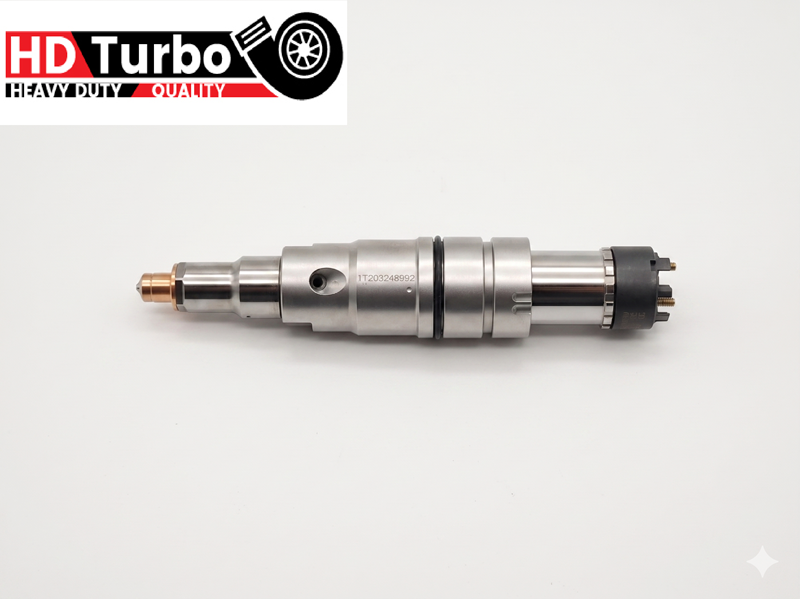
Key Insights
- The CM platform determines your injector, not the engine name. CM871 (EPA07), CM2250 (EPA10), CM2350 (EPA13/EPA17), CM2450 (EPA17/EPA21) each take different part numbers.
- The critical boundary is CM871 → CM2250 around 2010, where Cummins moved from HPI-TP dual-cam to XPI common-rail single-cam. Injectors on either side are not interchangeable in any sense.
- The 2017 ISX15 → X15 rename was branding, not a hardware reset. Efficiency Series and Performance Series carry different calibrations; cross-reference rather than assume.
- Common XPI numbers: 2872405 (CM2250), 2897320 (CM2350), 4327147 (X15 CM2350/CM2450), with 5579421, 5579417PX, 5579415 and 2894920 as frequent cross-references. Always verify against ESN, Cummins supersedes numbers and suppliers add their own suffixes.
- Trim codes must be written to the ECM via INSITE after installation, mapped to the correct cylinder. Skip this and the engine runs on the old injectors’ flow characteristics: imbalance, balance codes, wasted fuel.
- Run a cylinder cutout test before condemning a set. One misfire is not evidence that six injectors are finished.
- Insist on flow-matched sets (matched to each other, not just individually in spec) and replace high-pressure lines, they’re not designed for indefinite reuse at 30,000+ psi.
The most expensive mistake in Cummins injector ordering isn’t buying a cheap injector. It’s buying a good injector for the wrong CM platform.
The ISX15 and X15 share an engine architecture, displacement, and a great deal of hardware. What they don’t share, across CM871, CM2250, CM2350 and CM2450, is injector part numbers, ECM calibration logic, or trim-code handling. A CM2250 injector will be physically installed in a CM2350 engine. It will also run badly, set cylinder-balance codes, and cost you the labour twice. Here’s how to get it right the first time.
Identify Your CM Platform First, Not Your Engine Name
“ISX15” and “X15” are marketing designations spanning nearly two decades. The CM (Control Module) designation is what actually determines your injector, and it maps to the emissions family.
| CM platform | Approx. model years | Emissions family | Fuel system | Notes |
| CM870 | 2003–2007 | EPA04 | Open rail / HPI-TP | Dual overhead cam. Different injection architecture entirely. |
| CM871 | 2007–2010 | EPA07 | HPI-TP | DPF introduced. Dual cam. |
| CM2250 | 2010–2013 | EPA10 | XPI common rail | Single-cam architecture arrives. SCR and DEF introduced. |
| CM2350 | 2013–2016 | EPA13 / GHG14 | XPI common rail | ISX15 designation continues |
| CM2350 / CM2450 | 2017+ | EPA17 / GHG17 | XPI common rail | Rebadged X15 — Efficiency Series and Performance Series |
| CM2450 | 2021+ | EPA21 | XPI common rail | Tighter software/injector pairing |
The single most important line in this table is the CM871→CM2250 transition. That’s where Cummins moved from the HPI-TP dual-cam architecture to the XPI common-rail single-cam architecture. Injectors either side of that boundary are not remotely interchangeable as they have different operating principles, different mountings, and different everything. If you’re not certain which side of 2010 your engine sits on, stop and check the ESN before ordering anything.
The second most important: the ISX15-to-X15 rename in 2017 was a branding change, not a clean hardware break. X15 Efficiency Series and Performance Series engines carry different calibrations, and injector part numbers, calibration codes, and ECM programming changed across generations even where the architecture didn’t. Fleets running mixed legacy and current equipment need to cross-reference rather than assume.
Common XPI Injector Part Numbers
These are the numbers you’ll encounter most on the XPI common-rail platforms. Treat this as a starting reference for identification, not as a substitute for verifying against your engine serial number.
| Part number | Platform | Notes |
| 2872405 | ISX15 CM2250 (EPA10) | Very common; widely cross-referenced |
| 2897320 | ISX15 CM2350 (EPA13) | Frequently listed for 600 hp applications |
| 4327147 | X15 CM2350 / CM2450 (EPA17+) | Current-generation Efficiency/Performance Series |
| 5579421 | ISX single cam / X15 | Common reman listing |
| 5579417PX | ISX15 | Common cross-reference |
| 5579415 / 5579415PX | ISX15 | Cross-reference |
| 2894920 / 2894920PX | ISX15 | Cross-reference |
For an independent view of the same mapping, G2 Diesel’s XPI reference documents these numbers alongside the same warning we’d give you: match the part number to the engine serial number, because using the correct part number is not optional on this platform.
The reason a table like this is insufficient on its own: Cummins supersedes part numbers, and reman suppliers add their own suffixes (PX, RX, and vendor-specific codes). A number that was correct three years ago may have been superseded twice. The authoritative source is your ESN checked against Cummins QuickServe Online, which returns the parts list for your specific engine build, not for your engine model.
Trim Codes and Why the Install Isn’t Finished When the Wrench is Down
Every XPI injector ships with calibration trim codes, a data string usually printed on the injector body and on a label in the box, that quantifies that individual injector’s flow characteristics relative to nominal.
Those codes must be written into the ECM using Cummins INSITE after installation, mapped to the cylinder each injector went into. Skip this step and the ECM commands fuel based on the previous injector’s characteristics. The engine will start and run. It will also deliver unbalanced fuel across cylinders, which shows up as rough idle, cylinder-balance codes, poor fuel economy, and elevated soot loading that drives regeneration frequency up.
Three practical consequences:
- Record which injector goes in which cylinder before you install. Recovering this afterward means pulling the valve cover again.
- Don’t lose the box labels. If the code label is gone and the body stamp is illegible, you have an injector you can’t correctly commission.
- Budget the software time. If your shop doesn’t have INSITE access, the job isn’t complete in-house. Factor it in before you start.
This is also a legitimate reason to buy from a supplier who supplies trim codes as a matter of course rather than as an afterthought.
Symptoms, and What They Indicate
| Symptom | Likely cause | Notes |
| Rough idle, single-cylinder miss | One failing injector — nozzle wear or internal leak | Run a cylinder cutout test in INSITE to isolate before replacing the set |
| Engine knock under load | Worn nozzle degrading spray pattern; poor atomisation causing rough combustion | Frequently mistaken for a mechanical knock |
| White or grey smoke, hard start | Injector not sealing; fuel dilution | Check oil level — rising oil level indicates fuel dilution |
| Excessive black smoke, high soot loading | Over-fuelling injector | Drives regen frequency up and loads the DPF |
| Frequent unscheduled regens | Main injector over-fuelling, or a failing aftertreatment doser | Diagnose both; these are commonly confused |
| Low power with no injector code | Rail pressure problem — HPFP or rail sensor | Don’t replace injectors on suspicion; verify rail pressure first |
| Fuel in coolant or coolant loss | Injector cup or sleeve failure | Different repair; injectors may be fine |
The diagnostic discipline that saves money: Run the cylinder cutout test before condemning a set. Fleets replace complete sets of six on the strength of a single misfire more often than they should. Sometimes a set is genuinely due, high-mileage engines with all six near end of life should be done together, and flow-matched as a set. But “one cylinder is down” is not by itself evidence that six injectors are finished.
Set Replacement, Flow Matching, and the High-Pressure Lines
When you do replace a set, three things are worth insisting on.
- Flow matching: A set of six should be matched to each other within a stated tolerance, not just individually within spec. Six injectors each at the outer edge of acceptable, some high, some low, will produce measurable cylinder imbalance even though every unit “passed.” Ask suppliers for the matching tolerance on sets, not just the pass criteria on units.
- High-pressure line policy: XPI operates at rail pressures above 30,000 psi. High-pressure fuel lines are torque-to-yield items on most platforms and are not designed for indefinite reuse. This is not a Cummins-specific caution, PACCAR’s service documentation warns explicitly that high-pressure fuel injection pipes are not intended to be reused indefinitely, and the same principle governs every common-rail platform. Replace them rather than gambling on a high-pressure leak in a hot engine bay.
- Cleanliness: Rebuilt or new, an XPI injector installed into a contaminated fuel system will fail early. If the old set failed from contamination, find and fix the source, such as water in the tanks, a failed filter, or a compromised fuel-water separator, before installing new units. Otherwise, you’re buying the same repair again on your own schedule.
Aftertreatment Fuel Injector — A Separate Component
Worth stating clearly because it causes real confusion: the ISX15 and X15 have a seventh injector that is not one of the six. The aftertreatment fuel injector sits in the exhaust after the turbocharger and injects diesel into the exhaust stream to raise temperature for DPF regeneration.
It’s part of an assembly including a fuel shutoff valve, a pressure sensor, and a purge air actuator, and the ECM runs a diagnostic pressure test on the whole system before every active regen. Faults set as SPN 3556 (Cummins fault code 1964). If your truck is derating and failing regens rather than idling roughly, this, not your main injectors, is where to look. We cover this in detail in the 7th injector and doser guide.
Verify Before You Order
The practical sequence:
- Find your ESN. Engine serial number, on the dataplate, not the truck VIN, though we can work from either.
- Confirm the CM platform and emissions family from the ESN.
- Check for supersessions on the part number your records show.
- Confirm single-cam vs. dual-cam architecture if you’re anywhere near the 2010 boundary.
- Confirm whether you need trim codes written, and who’s doing it.
Or skip the research and send us your VIN or engine serial number through the Make Sure It Fits form and we’ll confirm the correct part number for your specific engine build before you check out. In a market where a single platform generation carries seven-plus valid cross-references, that verification step is the difference between a repair and a return.
We stock remanufactured Cummins X15 injectors built on genuine OEM cores, flow-tested, supplied with trim codes, and covered by a 12-month unlimited-mileage warranty — contact us if you’re not sure it’s the right fit for your engine.
Cummins ISX15 and X15 Injector Part Numbers FAQs
How many injectors does a Cummins ISX15 or X15 have?
Six main injectors, one per cylinder, in the standard Cummins inline-six configuration. There is also a seventh injector, the aftertreatment fuel injector or hydrocarbon doser, mounted in the exhaust system after the turbocharger. It injects diesel into the exhaust stream to raise temperature for DPF regeneration and is not one of the six combustion injectors.
Are ISX15 and X15 injectors interchangeable?
Not reliably. The X15 is the direct successor to the ISX15 and the platforms share architecture, but injector part numbers, calibration codes, and ECM programming changed across generations. The determining factor is the CM platform and emissions family, not the engine name. Always match the injector to your specific engine serial number and CM designation rather than to the model badge.
What is the part number for a Cummins ISX15 injector?
It depends on the CM platform. Common numbers include 2872405 for ISX15 CM2250 (EPA10), 2897320 for ISX15 CM2350 (EPA13), and 4327147 for X15 CM2350 and CM2450 (EPA17 and later). Frequent cross-references include 5579421, 5579417PX, 5579415 and 2894920. Because Cummins supersedes part numbers and remanufacturers add their own suffixes, verify against your engine serial number before ordering.
What is the difference between HPI and XPI injectors on a Cummins ISX?
HPI-TP is the earlier open-rail architecture used on CM870 and CM871 dual-overhead-cam engines through roughly 2010. XPI is the high-pressure common-rail system introduced with the single-cam CM2250 platform for EPA10. They operate on entirely different principles and their injectors are not interchangeable in either direction. This 2010 transition is the most important compatibility boundary on the ISX platform.
Do Cummins X15 injectors need to be programmed?
Yes. Each XPI injector ships with calibration trim codes that quantify that specific unit’s flow characteristics. Those codes must be written to the ECM using Cummins INSITE after installation, mapped to the cylinder the injector was fitted to. Without this step the ECM commands fuel based on the previous injector’s characteristics, producing cylinder imbalance, balance-rate fault codes, poor fuel economy, and elevated soot loading.
Should I replace all six Cummins injectors at once?
It depends on mileage and diagnosis. On a high-mileage engine where all six are approaching end of life, replacing the full set as a flow-matched group is the sound decision. On a lower-mileage engine with a single confirmed failure, replacing one unit is legitimate. Run a cylinder cutout test in INSITE to isolate the affected cylinder before deciding, a single misfire is not by itself evidence that all six injectors are finished.
What are the symptoms of a bad injector on a Cummins ISX or X15?
Rough idle or a single cylinder miss, engine knock under load from degraded spray pattern, white or grey smoke with hard starting, excessive black smoke and rapid soot loading from an over-fuelling injector, and rising engine oil level from fuel dilution. Note that low power with no injector fault code more often indicates a rail pressure problem, high-pressure fuel pump or rail sensor, than an injector fault, and that frequent unscheduled regenerations may be the aftertreatment doser rather than a main injector.
Do you need to replace high-pressure fuel lines when changing ISX15 injectors?
It’s strongly recommended. XPI systems run rail pressures above 30,000 psi and high-pressure fuel lines are torque-to-yield components not designed for indefinite reuse. Reusing a line that has been loosened and re-torqued risks a high-pressure fuel leak in a hot engine bay. Manufacturer service documentation across common-rail platforms consistently warns against indefinite reuse of high-pressure injection pipes.
Mission
We have ONE GOAL – provide you with a MORE POWERFUL and MOST RELIABLE turbocharger for years to come.
High Quality Products
Heavy-duty turbochargers are high-quality, produced in a state-of-the-art facility capable of balancing turbo components as well as whole rotating assemblies. Strict quality control.
Great Team
Our dedicated and detail-oriented team is always happy to help you – don’t hesitate to reach out with questions or comments.
NEED HELP?
GOT QUESTIONS?
Want to talk to our support team? Call us at (847) 258-3785
WE SHIP TO ALL 50 STATES. ORDER TODAY
HD Turbo ships diesel turbo parts and actuators to all 50 states.
-
Fast nationwide shipping on in-stock parts
-
Free return label to return the core (excl. Alaska, Hawaii, Puerto Rico).
-
Technical support available
SHOP
Product Categories
Diesel Turbos by Brand
- Cummins Turbos
- Detroit Turbos
- Paccar Turbos
- Mack Turbos
- Volvo Turbos
- Dodge Ram Turbochargers
- Mercedes Sprinter Turbos
Diesel Turbo Actuators by Brand
- Cummins Actuators
- Detroit Turbo Actuators
- Paccar Trubo Actuators
- Mack Truck Turbo Actuators
- Volvo Truck Turbo Actuators
Popular Diesel Turbos
- 6.7 Cummins Turbochargers
- Holset Turbos
- Cummins ISX Turbo
- Volvo D13 Turbos
- Mack MP8 Turbocharger
- Mack E7 Turbos
- HE451VE Turbos
Popular Diesel Turbo Actuators

2250 Estes Ave,
Elk Grove Village, IL 60007
Mon-Fri: 8AM - 4.30PM
Sat: 8AM - 12.00PM
Sun: Closed
 Authorized Dealer
®2018-2026 HD Turbo, LLC. All rights reserved.