The Cummins X15 is one of the most advanced and widely deployed heavy-duty diesel engines on the road today. Its precision fuel injection system delivers the power, torque, and fuel economy the engine is renowned for, and it is also the system most likely to bring your truck to a halt when something goes wrong.
Understanding what causes X15 injector failure is not just useful knowledge for diesel technicians. It is critical intelligence for fleet managers, owner-operators, and anyone responsible for keeping trucks on the road. This guide breaks down the four root causes of X15 injector failure based on real-world teardown data from remanufacturing experience, so you know exactly what to watch for and when to act.
1. Fuel Pump Debris and Metal Shavings — The “Death Whirl”
The most common and most destructive cause of X15 injector failure begins not with the injectors themselves, but with the high-pressure fuel pump. When internal pump components disintegrate, particularly ceramic plungers, they shed microscopic metal shavings directly into the high-pressure fuel rail.
Once that debris enters the rail, it circulates through every injector simultaneously. Think of it as liquid sandpaper running at extreme pressure through components machined to tolerances measured in microns. The metal particles scar the internal needle valves and metering components, and because all six injectors share the same rail, the damage is almost never limited to a single unit.
The result is what experienced diesel technicians call the “death whirl”: a cascading failure in which one pump event destroys the entire injector set. Rough running, misfires, and fault codes across multiple cylinders appear quickly. By the time those codes surface, the damage is typically done.
What to watch for: Multiple cylinder misfire codes appearing simultaneously, especially following a high-pressure fuel pump replacement or confirmed pump failure. All six injectors must be inspected before the engine returns to service.
2. Fuel Contamination — Water and Dirt
Common-rail injectors like those in the X15 operate under extraordinary pressure, up to 30,000 PSI, and rely entirely on diesel fuel for internal lubrication. That makes fuel quality not a preference but a survival requirement for the injection system.
Water contamination is particularly damaging. When water flashes to steam inside an injector operating at extreme pressure and temperature, it erodes the nozzle tip and can crack it entirely. A cracked nozzle tip allows combustion gases to enter the injector body, causing secondary damage that typically makes rebuilding impossible.
Dirt and fine particulate matter introduced through infrequent fuel filter changes or low-quality fuel cause a different but equally serious failure mode. Abrasive particles erode the precision spray orifices in the nozzle tip, distorting the spray pattern. Instead of a fine atomized mist, the injector delivers a solid fuel stream into the cylinder. The result can be melted pistons, scored cylinder walls, and catastrophic engine failure.
Prevention is straightforward: change fuel filters at or before the manufacturer’s recommended interval, use a quality diesel source, and install a water separator if operating in high-humidity environments.
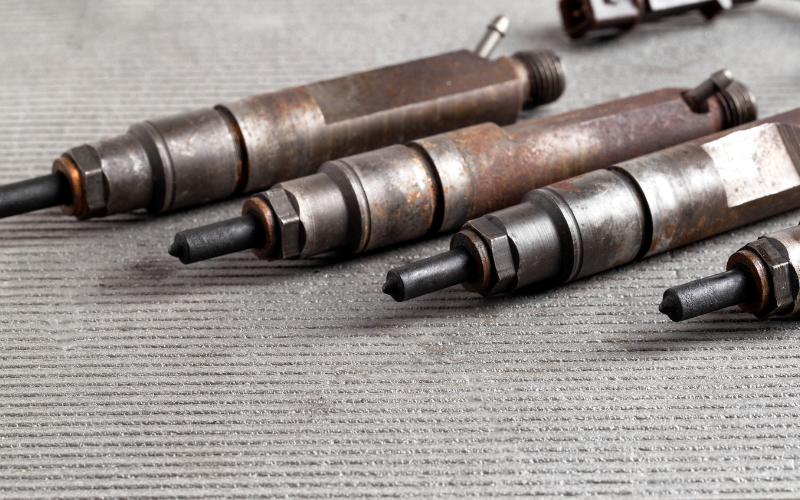
3. High-Pressure Return Flow and Internal Body Wear
This failure mode is less dramatic than contamination but far more common in high-mileage X15 engines: the slow accumulation of internal wear over millions of injection cycles.
X15 injectors cycle approximately 800 to 1,200 times per minute under load. Over hundreds of thousands of miles, the precision surfaces inside each injector, the needle seat, the control valve, the barrel and plunger, gradually wear beyond specification. When internal clearances open up, the injector can no longer hold pressure effectively. Excess fuel bypasses the control valve and returns to the low-pressure side rather than being delivered to the cylinder.
The symptoms are gradual but telling, reduced power output, declining fuel economy, hard starts, and extended crank times. Cylinder contribution testing via Cummins INSITE will identify the degraded cylinder and confirm excessive return flow on the affected injector.
Unlike contamination failures, wear-based failures rarely damage neighboring injectors directly. That said, on a high-mileage engine, if one injector has worn out, the others are likely approaching the same threshold. An engine-wide inspection is warranted whenever high return flow is confirmed on any unit.
4. Severe Carbon Coking and Tip Damage
Coking is the industry term for the carbon deposits that accumulate on the injector tip when combustion conditions are poor. At the operating temperatures inside an X15 combustion chamber, unburned hydrocarbons polymerize and bake onto the metal, sealing the micro-holes in the nozzle tip with carbon cement.
The primary causes of severe coking are extended low-load idling, common in long-haul trucks running without an active auxiliary power unit, and emissions system malfunctions that elevate combustion temperatures above normal. A dirty or stuck-open EGR system is a particularly common culprit in X15 coking failures.
Once spray holes are blocked, the injector can no longer produce the atomized spray the combustion chamber requires. Fuel-air mixing degrades, combustion becomes uneven, and the engine responds with black exhaust smoke, rough idle, power loss, and rising exhaust temperatures. In advanced cases, concentrated heat and pressure at the blocked tip cause physical tip cracking.
Regular EGR system inspection, proper aftertreatment maintenance, and minimizing unnecessary idle time are the most effective preventive measures against coking-related injector damage.
Key Takeaways
- Fuel pump failures are the #1 cause of X15 injector damage. When the pump fails, all six injectors must be inspected before the engine is returned to service.
- Water in the fuel destroys the lubricity diesel injectors depend on for survival. A water separator is inexpensive insurance on a costly injector set.
- Wear-based return flow failure is a normal outcome at high mileage. Cummins INSITE return flow data is the most reliable early warning tool available.
- Carbon coking is largely preventable through EGR maintenance and avoiding excessive idle cycles.
- Always diagnose the root cause before ordering replacement injectors. Installing a new set into a contaminated fuel system guarantees a repeat failure.
Frequently Asked Questions
How do I know if my Cummins X15 injectors have failed?
Common signs include rough idle, hard starts, excessive black or white exhaust smoke, noticeable fuel economy drops, and active fault codes pointing to individual cylinders. The most reliable diagnostic method is a balance rate and return flow test using Cummins INSITE software. Any injector showing return flow above specification should be replaced.
Can one failing X15 injector damage the others?
Yes, in one specific scenario: if the high-pressure fuel pump fails and sheds metal debris into the fuel rail, all six injectors are typically contaminated simultaneously. In wear-based or coking failures, neighboring injectors are not directly affected, though high-mileage engines often have multiple injectors approaching end of service life at the same time.
How often should X15 injectors be inspected?
There is no mandatory stand-alone inspection interval, but monitoring balance rates and fuel economy trends via INSITE is recommended at every major service interval after 300,000 miles. Whenever a high-pressure fuel pump is replaced, injectors must be inspected for debris contamination before the engine returns to service.
Does fuel quality make a significant difference to X15 injector lifespan?
Yes, significantly. X15 common-rail injectors operate at up to 30,000 PSI and rely on diesel fuel for internal lubrication. Water contamination and abrasive particles cause irreversible damage that no amount of careful installation can undo. Running quality fuel through clean, regularly replaced filters is the single highest-return preventive maintenance step for the X15 fuel system.
Can a coked X15 injector be cleaned rather than replaced?
In mild cases, ultrasonic cleaning can remove carbon deposits from accessible surfaces. However, coke that has blocked the spray orifices typically cannot be fully cleared without damaging the nozzle’s precision geometry. A properly remanufactured injector with a new nozzle installed is the more reliable solution for a heavily coked unit.
Mission
We have ONE GOAL – provide you with a MORE POWERFUL and MOST RELIABLE turbocharger for years to come.
High Quality Products
Heavy-duty turbochargers are high-quality, produced in a state-of-the-art facility capable of balancing turbo components as well as whole rotating assemblies. Strict quality control.
Great Team
Our dedicated and detail-oriented team is always happy to help you – don’t hesitate to reach out with questions or comments.
NEED HELP?
GOT QUESTIONS?
Want to talk to our support team? Call us at (847) 258-3785
WE SHIP TO ALL 50 STATES. ORDER TODAY
HD Turbo ships diesel turbo parts and actuators to all 50 states.
-
Fast nationwide shipping on in-stock parts
-
Free return label to return the core (excl. Alaska, Hawaii, Puerto Rico).
-
Technical support available
SHOP
Product Categories
Diesel Turbos by Brand
- Cummins Turbos
- Detroit Turbos
- Paccar Turbos
- Mack Turbos
- Volvo Turbos
- Dodge Ram Turbochargers
- Mercedes Sprinter Turbos
Diesel Turbo Actuators by Brand
- Cummins Actuators
- Detroit Turbo Actuators
- Paccar Trubo Actuators
- Mack Truck Turbo Actuators
- Volvo Truck Turbo Actuators
Popular Diesel Turbos
- 6.7 Cummins Turbochargers
- Holset Turbos
- Cummins ISX Turbo
- Volvo D13 Turbos
- Mack MP8 Turbocharger
- Mack E7 Turbos
- HE451VE Turbos
Popular Diesel Turbo Actuators

2250 Estes Ave,
Elk Grove Village, IL 60007
Mon-Fri: 8AM - 4.30PM
Sat: 8AM - 12.00PM
Sun: Closed
 Authorized Dealer
®2018-2026 HD Turbo, LLC. All rights reserved.